
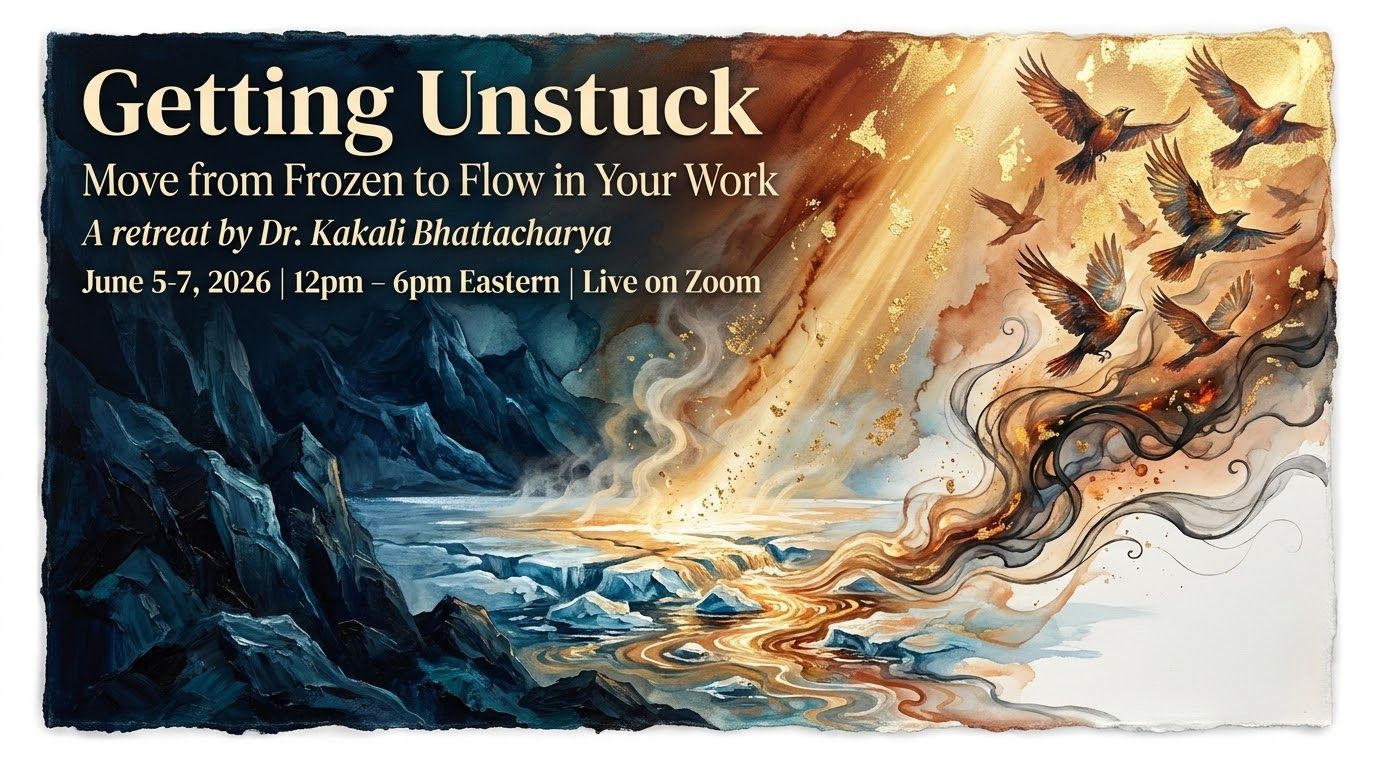
The stuckness is never about the task.
It is about what you learned to hide to survive in spaces that were never designed for you to thrive.
"I have the ideas, the data, and the stories. But I am frozen. I cannot get any of it onto the page."
"I no longer want to hide behind concepts and jargon. I want to bring an embodied, urgent and yet unhurried approach to my writing."
"I feel burned out and am not sleeping well. The lack of sleep is making me foggy and I waste time feeling overwhelmed and crying at my desk with my office door closed."
These are some things my mentees tell me regularly.
Now let's focus on you. Which of the following statements are true for you?
If you said yes to even one statement, then I will tell you what I say to my mentees:
The freeze is not the issue. Somewhere along the line you learned to hide, play small, and be invisible as a survival strategy. But it hasn't brought you safety. Your desire to stay hidden by playing small still doesn't protect you. You still experience stress, anxiety, and vulnerability.
You're frozen because it is a learned behavior of self-preservation. But it is doing the opposite of preservation. It is creating self-sabotage.
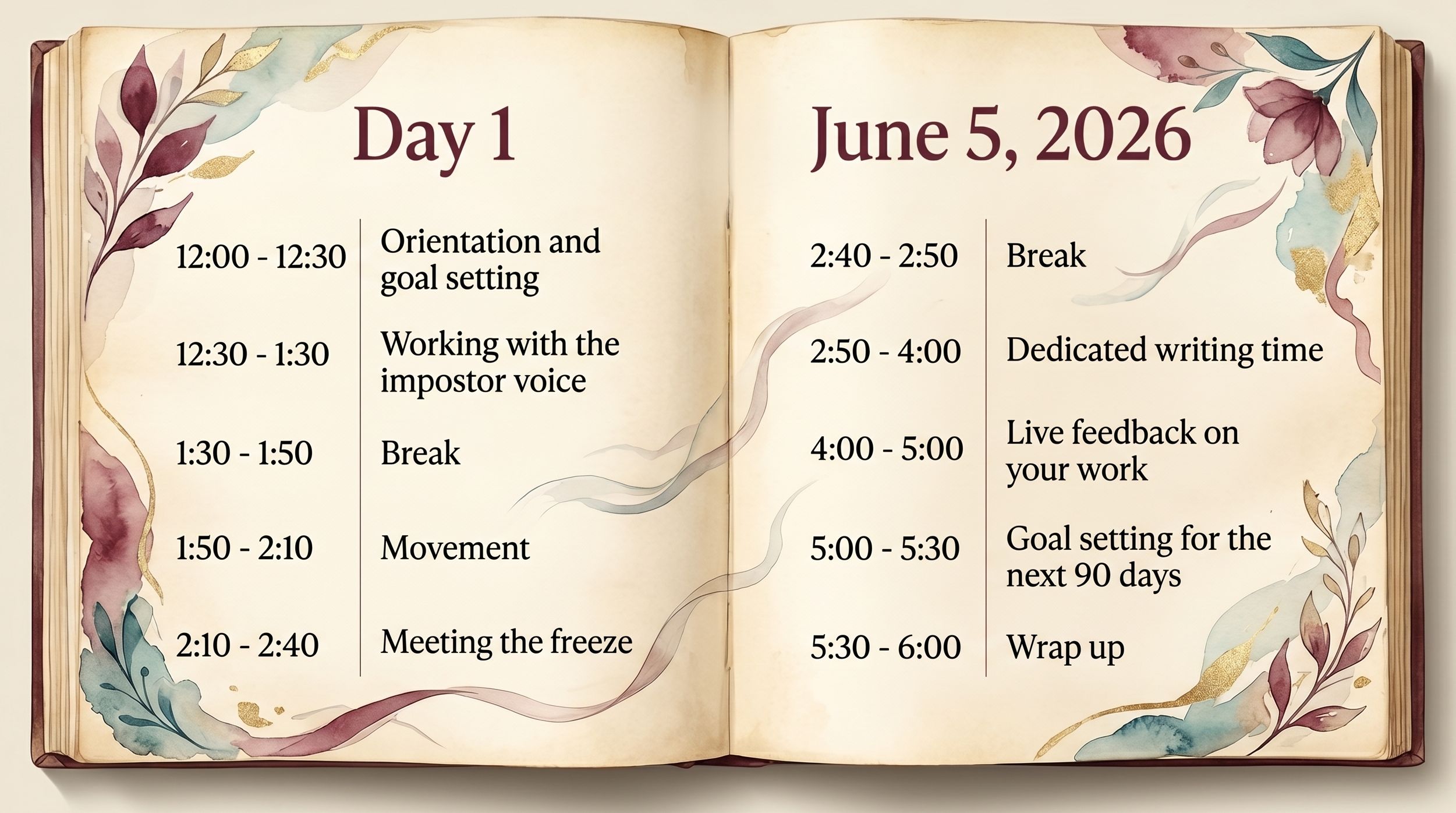
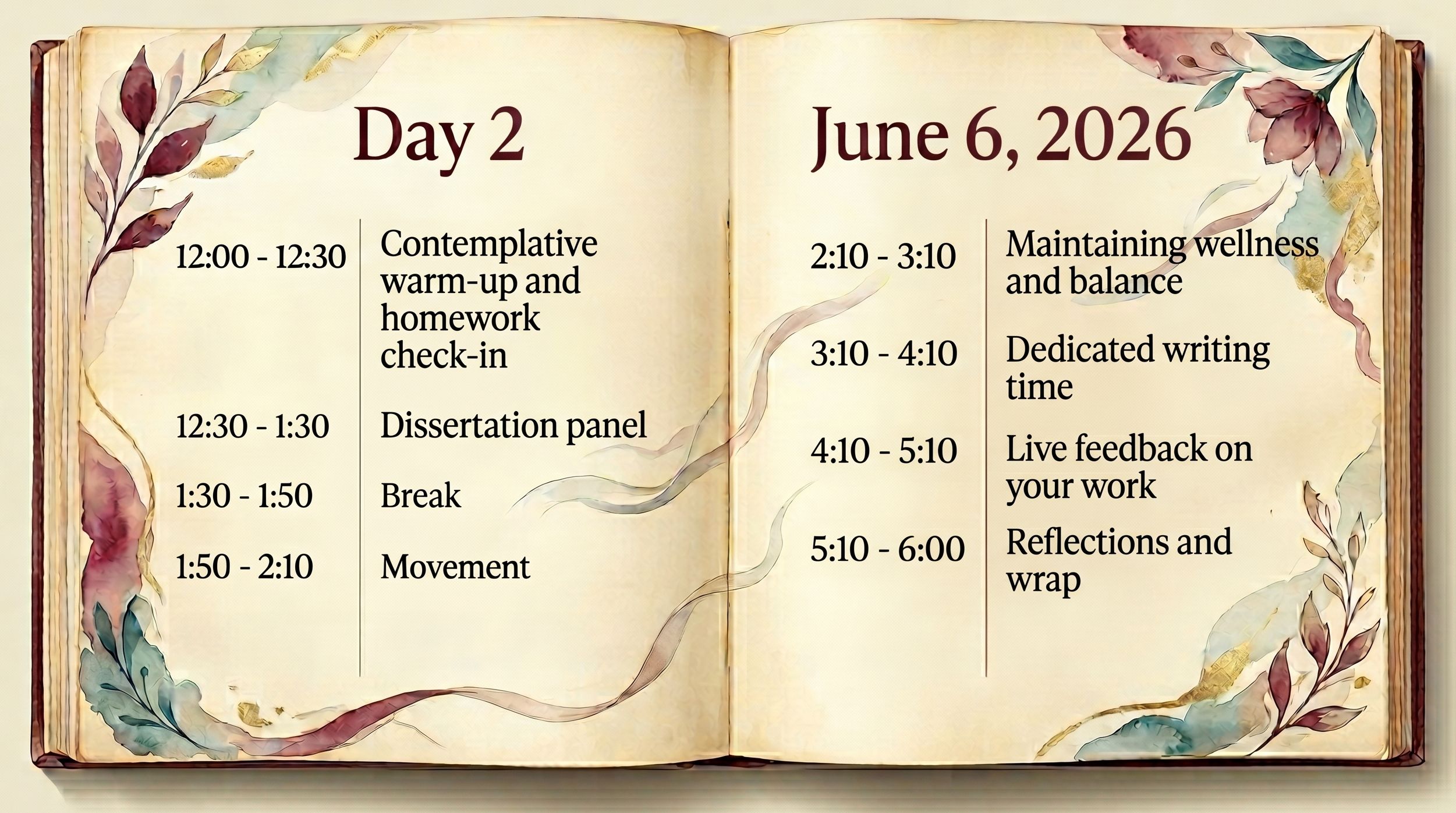
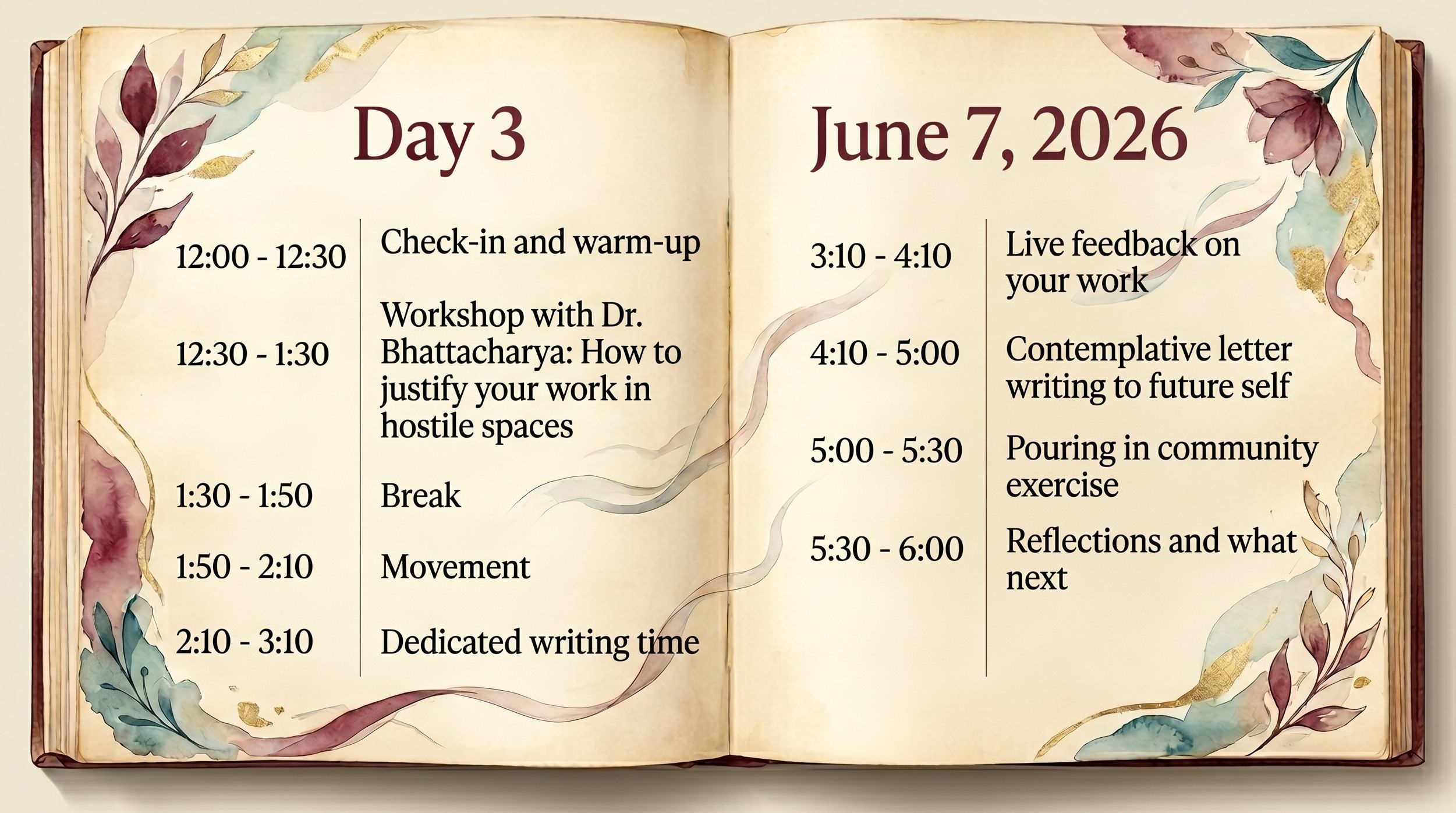
When: June 5-7, 2026
Time: 12pm - 6pm Eastern each day
Format: Live on Zoom. Recordings available for 60 days. Zoom link sent via email after purchase.
What is staying frozen costing you?
If this question created anxiety, you already know: the time is now to walk through the door that is open for the version of you that is ready to stop hiding.
What would unthawed momentum feel like? Especially when you're not fragmenting yourself?
The Fragmented Self
It is 9:04am. You open your document and realize you have to understand where you left things off. It overwhelms you to read through a lot before you can even begin to write. At 9:10am you close the document and start doing dishes.
The Aligned Self
It is 9:04am. You open your Grand Project Narrative document. It lists the work you did last time and where you need to start today. Energized, you begin the work.
The Fragmented Self
You write a sentence that sounds similar to a theoretical paper you read and cited. But it does not carry your voice, spirit, and soul. You experience some resentment for having to perform in a masked or fragmented way.
The Aligned Self
You read theoreticians who write from embodied perspectives. Activated, you write a poignant, embodied theorization that is resonant for your readers. You experience joy for not writing from a fragmented self.
The Fragmented Self
You write a sentence that says what you actually think. You read it back. You second-guess yourself and think it is trash. You hear your advisor in your head. Then your committee. Then the reviewer who tore apart your last paper. You change the sentence to what you think will be palatable. You do this 47 times in one paragraph. You are not happy. You are stressed. You hope you have done enough.
The Aligned Self
You write a sentence that honors your wisdom and knowledge. You read it back and the voices of inner doubt ring loud in your head. You smile at them. You say, "I am aligned with my framework." You keep writing. You have just co-opted an academic structure for your benefit. Your paragraph is uniquely voiced with your sensibilities.
You smile.
This is a retreat where you get honest with yourself.
You stop hiding. You stop fragmenting.
Unfreeze me.What This Is
Getting Unstuck is where you learn to write, think, and work from the self you were told to hide.
Across three days, you will work on the project that has been frozen. You will practice the shifts you saw in the Before and After pairs. You will be given specific methods for reentry, for working with the voices of inner doubt, for writing from your sensibilities rather than around them.
Getting Unstuck is for graduate students, postdocs, untenured and tenured faculty, and independent scholars. It is for the academic who has the training, the material, and the desire. Your stuckness is about something older than the project itself.
You will leave with your Grand Project Narrative document started. You will leave with a reentry method you can use for the next project and the one after that. You will leave knowing how to stand in your own framework while you co-opt academic structures for your own benefit. You will leave with momentum.
"This process has been positively transformative. I suspect as I look back on my career twenty years from now, this will be a pivotal moment in my personal and professional timeline. The biggest challenge I brought was writer's block, and I left feeling like that block had been chipped away at and dislodged."
Dr. Kiersten Greene
Associate Professor and Director, Childhood Education
Hunter College, CUNY
What Happens Across the Three Days
🧳 What You Walk Away With
What Stops.
You stop opening your document at 9am and closing it at 9:04am due to overwhelm. You feel energized to continue following your notes from your Grand Project Narrative document.
You stop rewriting the same paragraph 47 times because you trust your voice and agency.
You operate from your whole self because performing a fragmented version of you creates self resentment, stress, and anxiety.
You live with less anxiety at the end of each week because you no longer collapse from the stack of work you avoided.
How the Work Gets Done.
"I will take away the narrative writing techniques Dr. Bhattacharya outlined, such as virtue signaling and ensuring that every detail and description serves multiple functions in writing. Incorporating narrative writing is non-negotiable in the doing and writing of qualitative research."
Dr. Tairan Qiu
Assistant Professor
Stanford University
⚡ What Shifts Right Away.
In the weeks after Getting Unstuck:
You open your document and you stay.
You write the paragraph that has been sitting in your head.
You open the chapter and work on it.
You draft the grant application.
You read the feedback and sort it into what you can use.
"I was able to refine my dissertation prospectus and received minimal feedback from my committee because of what I learned. I left feeling grounded. When I re-engage with research there is an indescribable sense that I am centered right where I need to be for the task in front of me."
Dr. Rhemma Payne
Assistant Professor
Western Kentucky University
🌅 What Becomes Possible.
One year from now, you have momentum in your work, finished projects, and new ones that excite you.
Five years from now, you have mapped a terrain for your work from your full beingness. Your knowledge and wisdom have unfiltered expression.
Ten years from now, you have created a body of work that excites those who come behind you. Your work inspires others and energizes you to keep working from an evolving understanding of the legacy you are building.
You are in academia as yourself.
At the Getting Unstuck Retreat, You Can:
Write from your whole human perspective with the ground to hold under pressure.
Move from frozen to flow without performing productivity culture.
Return to your work without becoming someone you are not.
Questions to Sit With
Is it your time yet?
If not now, then when?
If you don't address this problem, then what happens in:
What does an accelerated version of this problem cost you?
Are you prepared to pay that cost that inevitably harms you?
"I didn't realize how powerful it was to think through the narrative writing process with Dr. Bhattacharya's teaching, and then being offered the time to actually write freely. The narrative I drafted for a paper was so powerful I even surprised myself after I finished writing it during this workshop."
Dr. Tairan Qiu
Assistant Professor
Stanford University
Who This Is For
Getting Unstuck is for You if:
You have the training, the material, and the desire. The freeze is what is in the way.
You are ready to stop performing a fragmented version of yourself.
You are ready to write, think, and work from your whole self.
You are neurodivergent, caregiving, racialized, first-generation, immigrant, queer, disabled, mothering, or some combination. You have been surviving academia as yourself. You are ready to thrive in it as yourself.
You want methods you can take home, not just motivation.
Getting Unstuck is not for You if:
You're perfectly fine with how you move in academia.
All your academic moves are supported and never scrutinized.
You are not coachable.
You would rather get a quick productivity fix than dig deeper into what your stuckness is trying to teach you.
You are not ready to do deep work that creates momentum without performativity.
You would rather perform smartness than operate from your wholeness.
"Dr. Bhattacharya was extremely personable and open. I dread interacting during workshops and like to blend into the background, observe, and gather information. But Dr. Bhattacharya brought me into the fold almost immediately upon entry into the workshop. She had a way of making the virtual space supportive and welcoming, her affect was everpresent."
Dr. Luke LeFebvre
Associate Professor, School of Information Science
University of Kentucky
👋🏽 Meet Your Instructor

Dr. Kakali Bhattacharya
I help you dig out the question hidden behind the question you are actually asking. Then we get somewhere real. Then what we co-create has weight. It matters more than what you do or how you show up in academia. It informs and influences every aspect of your life.
This is what I wish someone had done for me when I first arrived in academia.
I came to qualitative research from a heavy scientific and post-positivist background. My undergraduate years were in biochemistry and psychology. My graduate work was in instructional design and technology. When I met qualitative research, I had no skills for writing from my whole self, for trusting my own voice, or for holding my ground in spaces that did not expect me to be there.
Over the years, I heard the same words from people in power. Dial it down. You are too much. You are too intense. You are intimidating.
I did the thing you may be doing now. I hid most of myself. I put my head down. I did the work.
The hiding did not protect me. My excellence exposed other people's mediocrity, and they came for me anyway. I was professionally attacked. Barriers were placed against my success. In one instance, people worked hard to get me fired.
That is when I understood that palatability was not protection. Excellence was not protection. Silence was not protection.
I had to make a tough decision about where I was spending my energy so I would not burn out over the long run.
What I teach in Getting Unstuck is what I built to unfreeze myself. I have spent 20+ years refining it with mentees. I have published over 100 articles and chapters, created Par/Des(i) ontoepistemologies for South Asian diasporic realities, and developed the specific protocols you will work with in this retreat. I have won national and international awards for outstanding scholarship, mentoring, and contribution to qualitative research.
None of this is in a methods textbook. It is what I needed to stay in academia as myself without disappearing, and it is what you will learn to do here.
"You have a way of asking questions that makes me think about other things. It connects to other things. It was a different way of strategizing, bringing back pieces I had buried in myself. You create an environment where we feel safe to share our vulnerabilities."
Dr. Dina Maramba
Full Professor
Claremont Graduate University
Frequently Asked Questions
I have been stuck for years. Will three days actually work for me?
Yes, if you come in ready to look at what the stuckness is protecting. Getting Unstuck is not about unfreezing you overnight. It is about giving you the methods and the specific agentic moves you need so you can maintain the momentum even after the retreat ends.
Is this for neurodivergent people?
Yes. The retreat is paced for neurodivergent nervous systems. Short working blocks. Movement breaks every day. Contemplative warm-ups. Structured writing time with clear frames. You are not expected to perform neurotypical attention or productivity.
What if my project is not a writing project? Can I come if I am stuck on data analysis, a grant, teaching prep, or a tenure file?
Yes. The freeze does not discriminate by task. Whatever project is frozen, bring it. The methods you learn transfer.
Do I have to share my writing out loud?
No. You choose what you share and when. The hotspot feedback sessions are optional if you prefer not to volunteer your work. You will still benefit from watching others receive feedback.
What if I cry?
You cry. You are in a room with other academics who understand. Tears are expected on work this deep and do not interrupt the retreat.
What if I cannot attend all three days live?
Recordings are available for 60 days after the retreat. Live attendance gives you access to hotspot feedback and community practices that recordings cannot replicate, but missing part of a day is survivable.
I have tried other retreats and programs and they did not work. Why would this one?
Getting Unstuck addresses what is actually under the freeze. You walk out with methods you can use on your own when you return to your work.
Price
What is Included
- Three days of live retreat (18 hours total)
- Live hotspot feedback on your work
- Recordings available for 60 days
- Grand Project Narrative document template
- Workshop materials
- Dissertation panel access
- Community of fellow academics
- A post-retreat learning aid built from the questions and discussions that surface during the three days
Refund Policy
No refunds. Once the retreat runs, my time and labor cannot be returned.
💼 Making the Ask
Many academics secure institutional funding for professional development. Getting Unstuck is eligible for department professional development funds, dean's discretionary funds, faculty development office budgets, and provost-level funds.
Before You Ask
Asking for institutional support is not asking for a favor. It is advocating for an investment that benefits you, your sponsor, and your institution. There might be various pockets of fund that can support you institutionally or you might have someone sponsor you. Before you make the ask think of how such a sponsorship benefits you and the sponsor. This needs to be a win for all parties.
A win for you.
A win for your sponsor.
A win for your institution.
So work it out in your mind first what these wins could be.
How to Prepare
Identify potential sponsors.
Department chairs, dean's offices, faculty development offices, provost's offices, centers for teaching and learning, professional organizations connected to your role.
Do your homework.
Be ready to describe what the retreat is, why it fits right now, what outcomes you expect, and how the benefits extend beyond you.
Request a meeting.
Keep outreach brief. Face-to-face is ideal. A concise email works if scheduling does not allow.
During the conversation.
Focus on connection and alignment, not persuasion. Expect questions about cost, relevance, or need. These are normal and give you a chance to reinforce alignment.
After the conversation.
If yes, confirm in writing and share materials. If maybe, send a follow-up that formalizes the ask with additional context. If no, thank them for their time and move on to another sponsor.
Assess, adjust, ask again.
Support can come from multiple units. Partial funding is still progress. A no today may be a yes later.
Template to Adapt
Email Template
Subject: Request for Professional Development Support
Dear [Name],
I am requesting support to participate in Getting Unstuck: Move from Frozen to Flow in Your Work, a three-day retreat led by Dr. Kakali Bhattacharya, June 5-7, 2026.
Why now: I am [current position or transition]. I am working on [specific project]. I need focused support to move the work forward with momentum.
What it provides: Through this retreat, I will develop methods for sustained writing, reentry practice after breaks, and strategies for justifying my work in professional settings. I will return with a reentry protocol I can use on every project going forward.
How it supports our department: My progress on [project] contributes to [department goal, grant pipeline, publication pipeline, tenure timeline]. This investment accelerates what I am already accountable for.
Broader impact: I plan to share the methods with [colleagues, students, mentees] so the benefit extends beyond my individual participation.
The investment: $369.
I appreciate your consideration.
[Your name]
Adapted from NCFDD's Making the Ask guide.

P.S.
I see you. Uh huh, you. You scrolled all the way down here. You read all the things on the page. So here is a gem for you. Something on this page is drawing you in. Ask yourself what it is. If the answer is remotely close to resonance, then sign up for the retreat. If you'd feel more comfortable after talking to me first, send me an email.
Getting Unstuck exists because the freeze is never about the task.
It is for the academic whose stuckness is older than the project she is working on.
You learned to hide to survive. You can unlearn it here.